Showing posts with label Politics. Show all posts

Monday, August 3, 2015

The Big Bumble: The 2015 Canadian General Election

Sometimes, I think Canada should change it's name to Bumbleslavia, a land in which people bumble along and where bumbles are common and appreciated by the people: "Did you see the latest bumble?  Yeah, that was a good one. It will be hard to beat."

The latest Big Bumble -- methinks it will be in the running for the Grand Prize in the Bumble of the Year Awards -- is the Prime Minister calling a general election in the middle of the summer while most people are away on vacation, eleven weeks before the day of the election.

Why on earth would he do that?

Well, as could be expected, our government bumbled big time when drawing up the so-called, Fair Elections Act (ha ha ha, calling elections fair in Bumbleslavia always gets a laugh).  The Minister responsible for drawing up the law did not foresee that groups who do not support the ruling party would start spending large amounts of money to air television commercials critical of the government in anticipation of the upcoming election. 

Oops!  Easy to understand since Bumbleslavia is running its first election where the date of the election was fixed by law, not that the Prime Minister is always bound to respect the laws his government draws up, the last general election was held before the fixed date!

But as we like to say in Bumbleslavia, one good bumble deserves another.

In this case, there just happens to be a clause written into the Fair Elections Act (tee hee, sorry I couldn't help myself) that increases the amount of money political parties can spend during the election if the campaign is longer than the prescribed 37 days.  This election will be the longest in living memory and will double the spending limit.  Oh, I guess you should know that only the ruling party has enough money to do so, and taxpayers will be picking up half of the bill.  Oops!

Related Blogs

According to the former Director of Elections, this move on the part of the Prime Minister is gaming the system, running contrary to the notion of having fixed election dates and having fair elections (big chuckle).  In the Bumbleslavian way of thinking, the Prime Minister saw an opportunity to expose a bumble in the law and did so and should be applauded.

I think the former Director is just feeling grumpy because he no longer presides over the Bamboozling Bumble that goes by the name of the Canadian General Election.  What makes it really interesting is that governments are formed on the basis of the first-past-the-post voting method. 

Get this!  Governments are formed in Canada not on the basis of the popular vote, but on the basis of the number of electoral districts won by each party.  To win an electoral district, a candidate doesn't need a majority of the votes.  He or she just needs to get more votes than the other candidates.

Wow! That means that in a close three-way race, more people could vote for the two losing candidates combined than for the winning candidate.  Get out of town!

Wait, it gets better.  Counting up all the electoral districts, a party could form what in Bumbleslavia is referred to a majority government (guffaw) by winning half of the electoral seats that are up for grabs.  Doesn't that mean that the so-called majority government could get elected with substantially less than fifty percent of the vote?  Absolutely!  In other words, more people could have voted against the ruling party than who voted for it.  And you call that "Democracy"?
 
Oops, but only in Bumbleslavia.  You see, in Canada we take the Big Bumbles all in stride.  Don't worry.  Be happy.  Why fret about what we are really good at.

I love you Canada.

Bumble on and bumble strong in the Great White North!!!

Sunday, April 15, 2012

Canada's Greatest Cultural Achievement: The Charter of Rights and Freedoms


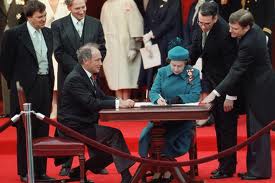
Thirty years ago, the Canadian government repatriated its constitution, thereby officially ending our colonial status, and added what is our greatest cultural achievement to date, the Canadian Charter of Rights and Freedoms.

No other document, song, poem, novel, film, or play has had such a profound influence on how Canadians are allowed to live their lives.

It represents the triumph of reasoned principle over the moral sentiments of those who would rule over us.

In short, it supplants the supremacy of Parliament with the notion of citizens holding inalienable rights subject to reasonable limits.

After it was adopted and as each landmark case made its way to the Supreme Court, slowly the face of the nation changed. Most visibly, the state was forced to withdraw from the bedrooms of the nation. It could no longer limit access to abortion and outlaw the civil union of same sex couples and, in the near future, will most probably lose its capacity to prevent sex workers from plying their trade in a safe and secure manner.

Moreover, the Charter prevents those who perceive themselves as being morally superior from violating the rights of those who are less fortunate. For instance, prisoners have had their voting rights restored and drug addicts can gain access to safe injection sites.

With the Charter in place, those who believe themselves to be "saved" can no longer discriminate against those they believe to be "dammed".

Let us not be mistaken. The adoption of the Charter represents the triumph of civic humanism over the sanctity of religious belief as it applies to the public sphere. It represents the triumph of the Age of Reason over the Age of Absolutism. It is the cornerstone of peace, order, and good government.

With the Charter of Rights and Freedoms in place, Canada is a far better place to live.

Friday, April 13, 2012

Maybe Canadians Don't Want to Live in a Democracy


In writing a scathing article that comes out and accuses the Conservative Government of having lied to Parliament and then to the Canadian people with regard to the costs of procuring the F-35 jet fighters, Andrew Coyne ends his piece with an interesting observation: "it is about whether we live in a functioning Parliamentary democracy, or want to."

Well, elsewhere people would be morally outraged that an election was first precipitated and then fought on the basis of the government willfully withholding information concerning the largest purchase ever.

Not so in Canada.

In fact, the support for the Conservatives in the polls has hardly budged, which indicates to me that Canadians are profoundly disinterested in the manner in which they are governed. They would rather watch hockey.

After all, democracy requires engaged citizens who keep themselves informed and are prepared to hold their elected representatives accountable for their actions.

But this requires concerted effort and Canadians are notoriously lazy.

As long as we are left alone to lead our little lives, we don't care about how we are governed.

Go Leafs Go!

Monday, April 9, 2012

Millennials Are Changing the Face of Canadian Politics


Change the manner in which information flows and the power structures will soon follow.

Politics are changing in this country and for once it’s not because of the blasted baby boomers, although they have played a hand in bringing about the change because it is their offspring that is changing the face of Canada.

Unlike their parents, who are often technologically challenged, the Millennials have grown up with the Internet, and it is unquestionably an integral part of their social networks.

Mom and dad, on the other hand, grew up watching broadcast television, never ever fully realizing that they were the product being offered up to powers that controlled a consumer culture that effectively co-opted the counter culture of the sixties and repackaged it by integrating their values into creative marketing campaigns.

Yet kids are extremely hip to the follies of their parents.

The Millennials have taken the progressive elements of the baby boomer zeitgeist and stripped it of its crass conspicuous consumption.  This is not to say that the yuppie strain has been eradicated, but its effect has been sufficiently muted so the progressive tendencies of this generation stand out.

Remember this is the generation that elected Obama.  This the generation that created the huge wave in Quebec that brought the New Democratic Party to the status of official opposition, and in my opinion will elect the NDP in 2015.

It’s simply a question of cohort replacement.  As each year passes, they become a larger percentage of the electorate and they are much more politicized than their slacker predecessors, generation X.  At the same time, the older folk, who had the fear of God forced upon them, are dying off, taking with them the appeal of Christian identity politics and an overzealous respect for authority.

This is the first post-war generation that cannot be controlled by traditional broadcast media. 

It’s not that they have tuned out; they have switched platforms and, as a result, have gained collective control of what passes for communications.  For instance, the opinions expressed in their social networks carry much more weight than those heard on talk radio, or expressed by political pundits on television, or to be found in the op-ed pieces in newspapers.

Just as the industrial revolution ushered in a time of great social transformation, so will the digital information revolution, and no, it won’t be televised, but you can follow it on the web. 

Tuesday, April 3, 2012

Living in the Age of Stupid


I know that many before me have felt that they live during times in which their fellow man's limited intelligence rules the day, much to their chagrin. I can imagine how learned people felt in Europe during two thousand years of endless war and carnage, first in the name of God, then in the name of race.

In the words of Robbie Burns, "Man's inhumanity to man, makes countless thousands mourn!"

But I live in a different time and a different place.

I live in Canada, a country that is incredibly peaceful, yet incredibly complacent.

People here just want to get on with their little lives and don't want to be bothered with the details of the big picture, even if the big picture is signaling loud and clear that their children and their grand children might have great difficulty getting on with their little lives if we continue to live ours as if nothing was happening with regard to climate change.

I can't help thinking that we live in the Age of Stupid, the title of a mockumentary film starring the late Pete Postlethwaite, who plays a future archivist that looks at old footage from the year 2008 to understand why humankind failed to address climate change.

Given the overwhelming evidence that suggests that human activity is changing the planet's ecosystem at a rate never seen before and that global warming could bring about catastrophic climate change that would cause "countless millions to mourn", you have to be extremely thick not to get it.

Or, maybe it's just a question of the vast majority having their head up their ass, incapable of critical thought, being led by the hand by a bunch of greedy, lying, bastards.

Wednesday, October 27, 2010

We Need More Than Two Hands on the Wheel

Almost two years ago, Jean Charest the leader of a minority government in Quebec decided to call a general election to take advantage of a significant drop in the polls of the official opposition, the Action Democratic of Quebec. Our dysfunctional electoral system is unforgiving for political parties whose support is a mile wide but an inch deep. A 15 point drop in the popular vote reduced the number of ADQ seats in the National Assembly from 41 to 7. As a result, the Charest-led Liberals formed a majority government with the support of only 23% of the electorate.

During the campaign, which was launched at the onset of the Great Recession, Charest's slogan was that in troubled times, Quebec needed to have just two hands on the wheel. Two years later is there anyone -- other than die hard Quebec Liberal Party supporters -- that believes that Quebec is better off now that we have a false majority government rather than a minority government that depended on the support of another party to maintain a government.

Essentially, the incontestable control and political power Charest now enjoys means that he can effectively tell the rest of the population to go to hell with regard to holding a public inquiry into the link between the construction industry and the financing of political parties in Quebec. This would not be the case if we had a minority government or a majority coalition.

We thought that things had come to a head with the publication of an edition of Macleans magazine that claimed Quebec was the most corrupt province in Canada. The claim seemed to be dismissed in the media as another instance of Quebec bashing.

Well, a few weeks later we learn that a vast majority of appointees to the Boards of Directors to Quebec's crown corporations made financial donations to the Quebec Liberal Party. In the case of the most important, Hydro Quebec, 85% of the Board had contributed to the Liberals. No surprise that they would approve the award of approximately $800 million in contracts to the family businesses of Franco Fava, one of the Liberal Party's principle fundraisers.

Worse yet, new revelations have come to light. According to Montreal journalists, André Noël and André Cédilot, more than 600 businesses pay Mafia protection money in Montreal alone, handing organized crime leaders an unprecedented degree of control of Quebec's economy.

When questioned in the National Assembly, Charest made another pathetic reference to
his laughable Operation Hammer, and allowing the police squad, Quebec's answer to the Keystone cops, to do its job.

Without question, Quebec has come full circle to find itself exactly where it was 50 years ago. Charest has undone the work of Jean Lesage,and we have returned to the dark days of Duplesis.

Fool me once, shame on you. Fool me twice, shame on me. Voting out the Liberals will only treat the symptoms and not the cause of the problem. What underlies the manifestation of corruption and influence peddling is a political system that in effect places the control of the province's political machinery in the hands of the Premier.

From time to time, one of those hands slips into the public purse to provide support for one of his friends.

Therefore, what needs to be done is to bring more hands to the helm in order to share political power and the place to start is the electoral system. The abuse of power begins with the abuse of each voter whose vote is simply discarded and not used to determine who will seize power in Quebec, Canada, and all other countries which use a plurality voting system.

Sunday, September 27, 2009

Scorched-Earth Economics

As the week comes to an end, we witnessed what Globe and Mail columnist Jeffery Simpson referred to as tired rhetoric in that both the Liberals and Conservatives were spouting the importance of the return to economic growth as the means from which Canadians are going to collectively dig our way out of the huge financial hole that we have made for ourselves.

Nothing new here except, given the possibility of global climate change of catastrophic proportions, there is something that is pernicious. Indeed, vaunting economic growth in the face of the disconcerted efforts to limit global warming to only two degrees Celsius by the end of the century is tantamount to advocating a scorched-earth policy.

As a defence strategy, rendering a terrain inhospitable in order to limit the advance of hostile armies proved to be effective, most notably by the Russians in the face of Napoleon’s armies and then again when confronted by the Germans during the Second World War. Today, however, such tactics contravene the Geneva Convention:

It is prohibited to attack, destroy, remove or render useless objects indispensable to the survival of the civilian population, such as foodstuffs, agricultural areas for the production of foodstuffs, crops, livestock, drinking water installations and supplies and irrigation works, for the specific purpose of denying them for their sustenance value to the civilian population or to the adverse Party, whatever the motive.

Yet, from an intergenerational perspective, the effects of continued global economic growth is to render useless the indispensable components of human survival (air, water, topsoil, ambient temperature) for future generations. A quick glance of the global inventory of the basic natural necessities reveals rapid depletion of water tables and the depth of topsoil, while at the same time the level of green house gases and the acidity of the oceans rise at an alarming rate. The motive for implementing a scorched-earth policy is clear, the insatiable greed of those living in the present, and the means is the ever-increasing levels of production and material throughput that goes by a rather innocuous term, economic growth, most often measured by a nation’s gross domestic product.

Clearly, a drop in economic activity brings about some positive results for the biosphere. For example, during the global recession we have witnessed a significant drop in the production of green house gases. In a report due to be released this November, the International Energy Agency projects a drop in global carbon emissions by 2.6% this year. Closer examination reveals that in the United States carbon emissions dropped by 3.8% in 2008 as compared to 2007 and are projected to drop another 6.0% in 2009.

Faced with significant deficits and mountains of accumulated debt, politicians throughout the G-8 are reluctant to make tough choices such as reducing expenditures or raising taxes and are opting to finesse their way through current economic difficulties by monetizing the debt and planning for a return to economic growth, albeit with a greater risk of runaway inflation.

It should now be recognized that the risk of allowing the externalities of increased production to negate efforts to reduce green house gases renders this economic strategy worse than useless. It is as though present generations refuse to accept the folly of their ways and either refuse to recognize that continued growth models have the effect of scorching the earth for future generations or opt to delay the inevitable downshifting of material production as long as possible.

The substitution of the reduction of energy intensity in economic production (less units of energy used for each unit of GDP produced) instead of the absolute reduction of carbon emissions hides a malicious intent. Although greater energy efficiency is devoutly to be wished, in the absence of absolute caps placed on economic activity increased energy efficiency has the perverse effect of increasing energy consumption and consequently increasing carbon emissions. For example, the increased efficiency of steam engines during the Industrial Revolution brought about an increase in coal consumption, and the increased fuel efficiency of automobiles during the first oil crisis, led to an increase of the total number of kilometers driven, which caused an actual increase in overall gasoline consumption. The tendency for increased efficiency to lead to greater rates of consumption is know as the Jevons paradox.

A second counter-intuitive phenomenon known as the Easterlin paradox should also call into question the desirability of continued economic growth. In short, there is a large body of evidence that indicates that as a society develops rising material wealth stops making the population any happier. Looking at quality-of-life indicators for OECD countries, it appears that the importance of relative wealth, in other words, how the wealth is distributed, is more important than the absolute wealth of the nation. Moreover, the documented increase in unequal wealth distribution that has accompanied the last 25 years of economic growth has not brought about an increase in the well-being of the populations of developed nations where income disparities are large. On the contrary, there is evidence to show that this type of economic growth that has characterized the end of the 20th and beginning of the 21st century has actually led to a decrease of the quality-of-life indicators for the vast majority of the populations.

Faced with the urgency of curbing green house gas emissions and the dubious utility of continuing to use an increase in economic production as a means to increase the well-being of the population of a developed country, it is time that we abandon the economic growth at all costs paradigm in favor of steady state economy.

Keeping the economy at a steady state has the advantage of placing an absolute cap on economic activity so that increased efficiency in energy use actually brings about significant reduction in green house gases. Second, the acceptance of curtailing economic growth in the developed world would bring about a marked change in attitude from the developing world with regard to their growing economies.

Overall reductions in carbon emissions require that those who are largely responsible for the problem to assume a leadership role in bringing about the solution. It is folly to believe that the developing world will accept diminished growth of its material well-being while the developed world continues to deplete the world’s dwindling natural resources at an unsustainable rate.

To avoid the global tragedy of the commons situation, it is imperative that some of the nations of the developed world abandon their scorch-the-earth economic policies disguised in the pursuit of ever increasing production levels for an approach that can sustain life as we know it and carries the possibility of actually increasing the well-being of the majority of the population.