Friday, April 27, 2012

The Big Lie Reigns Over Us


Everybody knows that the dice are loaded
Everybody rolls with their fingers crossed
Everybody knows that the war is over
Everybody knows the good guys lost
Everybody knows the fight was fixed
The poor stay poor, the rich get rich
That's how it goes
Everybody knows
                                                                  Leonard Cohen

When I first started to write this blog, I was inspired by Vaclav Havel's essay, The Power of the Powerless, in which he asserts that we must refuse to live the lie and instead choose to live within the truth.

Yesterday, I learned that the Supreme Court of Canada refused to hear our appeal of the Quebec Court of Appeal's decision not to grant an injunction that would have declared the first-past-the-post voting method unconstitutional because it violates our Charter right to effective representation and our right to meaningful participation in the electoral process.

In short, we argued that effective representation requires effective vote,s and since the first-past-the-post method discards most votes, it violates the Charter's guarantee that each citizen has a right to effective representation.

Our second argument flows from the first.  Because a large number of votes are discarded there is an institutional incentive not to vote for political parties that have little chance of electing a candidate in a particular riding.  This is not the case with the major voting systems in use around the world.  They all have mechanisms that either aggregate votes or voting preferences so that almost all the votes are effective.  The first-past-the-post is the only voting system in use in the developed world that doesn't have such a mechanism.

I can't say that I was surprised by the decision.  After all, if the Supreme Court were to hear our appeal, the judges would have to confront the inconvenient truth that the political system that we inherited from the British is inherently undemocratic.

It is well-known and well-documented that within the Westminster Parliamentary system, a political party will most often form a majority government with less than the majority of votes.  In Canada that now means a majority government with less than 40% of the votes cast and ,once we factor in the low participation rate, less than 25% of the electorate.

Supposedly, the Charter is inspired by the values of a free and democratic society.  Yet, by not granting us leave to appeal, the Supreme Court has dodged the issue with dismissive silence, which is another way of saying that we live in a liberal democracy, meaning in Canada we are free from the constraints that the principles of democracy impose upon a society.

In reality, we live in a liberal oligarchy, which in reality means democracy for the few.

But hey, that's something everybody knows.

Repeat the big lie often enough and you'll have everybody believing it.


Wednesday, April 25, 2012

Have Another Doughnut America, Uncle Sam Wants You To Be Fat

The other day I was searching through the videos at Kahn Academy and I came across a series on the French Revolution. Intrigued, I decided to watch them.

As the chronology of events was laid out, the narrator kept coming back to the same point. In his opinion, one of the principle drivers of the revolution was that the people were starving, and this was the fuel that fired the revolutionary zeal.

Sometime later, I came across an article about the two French economists, Thomas Picketty and Emmanuel Saez, who have researched and written extensively on long-term income inequality in the US. The popular 99% vs. the 1% slogan used in the Occupy Wall Street movement can be attributed to their work.

In the article, the two influential economists raised the question, how is it that Americans put up with such high levels of income inequality, levels reminiscent of the Gilded Age?

Connecting the dots, I realized that the lack of a meaningful response from the masses can be attributed to the fact that in America the masses have become massive. Obesity rates have sky-rocketed. Depending on how obesity is measured, it now appears that as high as 60% of the popultion is obese.

The other thing to keep in mind is that there is social gradient to obesity, the poorer you are the more likely you will be obese in America. In other words, unlike the starving masses around the rest of the world and throughout history, poor people in America are much more likely to be obese.

That's a complete reversal of the social conditions at the time of the French Revolution and during the Great Depression in the United States. In short, in both instances food shortages were the drivers of social change.

Not so in today's America. Food is plentiful, cheap, and its production heavily subsidized by the US government. Unfortunately, if you eat a lot of the cheap processed food that is available in the US, you'll fall into the fat trap, and once you're in, it's extremely difficult to find your way out. Our bodies are genetically programmed to retain fat.

The other thing to keep in mind is that, as could be expected, obese people are less likely to be politically active: less likely to vote, and even less likely to show up for a political protest.

As a result, I think one of the major reasons why Americans put up with such high levels of income inequality is that in order to change this growing tendency in the US, a critical mass would need to mobilize. Unfortunately, those who would benefit most by reversing this trend are unable to get off their fat asses to even vote, never mind engaging in more meaningful political activity.

Looking at this phenomenon from a distance, it is utterly brilliant.

Turn the nation into one big fucking fat farm and you can rob the people of their collective wealth while they are sitting down in front of their big-screen, high-definition televisions, chowing down on an unlimited supply of Krispy Kreme Doughnuts.

Sunday, April 22, 2012

Oligarchic Rule Begets Crisis of Legitimacy in Quebec


In a democracy, there is a consensus that the rule of the majority is legitimate. Those who disagree with the will of the majority must respect the fact that they are in the minority and go along with the desires of the majority.

However, what happens when political decisions are made by a minority that has attained its status as the ruling oligarchy by fraudulent means?

Are those who disagree with the decisions made by an oligarchy that has obtained the power in such a way obliged to respect those decisions?

This is the nature of the social unrest that is fueling the violence of the university and college student strike in protest of a 75% rise in their tuition fees.

Keep in mind that from the Quebec point of view any comparisons to tuition fees in the rest of North America is moot since post-secondary education in France as in other European countries is free. Obviously, whether or not to charge tuition fees for post-secondary education represents a societal choice. As a result, how this decision gets made is of utmost importance for those who are affected, students, parents, and the society at large.

Remember the furor over the MacLeans magazine cover that touted Quebec as the most corrupt province in Canada. Well, the dust has settled and for most of us living here in Quebec there is little doubt that this indeed our reality. The only question that remains to be answered is how far and how deep does the corruption go?

From what we can tell so far, the entire political system is rotten to the core. Groups of individuals, including politicians (municipal and provincial), lobbyists, directors of engineering firms and construction companies, union representatives, and members of the criminal element actively collude to defraud the public under the guise of public works projects. It seems that members from each sector have a finger in the pie. At worst, public money is skimmed and then repurposed as contributions from the private sector to the political parties to finance their campaigns.

Needless to say, there has been a significant breach of trust, so much so that there exists amongst the population considerable doubt with regard to the legitimacy of Quebec's political institutions.

Consequently, it shouldn't come as a surprise that the segment of the society that has the least to lose over the short-term but the most to lose over the long-term refuses to go along with a decision made by a government which is perceived to be corrupt.

Why should they?

Rule of law is a pale substitute for government of, by, and for the people, especially when a self serving minority draws up the laws and then selects those who will interpret them.

At some point in time, it may occur to a sector of the population to contest more than just the decisions made by the ruling oligarchy and to contest the legitimacy of the political institutions that bring forward this particular power structure.

To do so would require a not so quiet revolution.

Tuesday, April 17, 2012

Baby Losers in Quebec Show Some Backbone


Ah, it is spring in Quebec and the university students in my town barricaded themselves in the main building of their university in defiant opposition to the court injunction that was granted that would prevent them from demonstrating on university grounds to protest a substantial rise in tuition fees.


Much to my delight someone in Quebec has finally has the balls to stand up and say “No” to one of, if not the most corrupt government in North America.

The same day that the injunction was granted, we learned that the former vice-premier of Quebec, Natalie Normandeau, was implicated in yet another political scandal plaguing the Jean Charest-led Liberals.

Engineering and construction firms held fund raisers on her behalf and she returned the favor by granting a 10 million dollar subsidy in support of one of their projects in clear opposition to the advice her ministerial officers had given to her. Hell, she even had the gumption to admit that she accepted tickets for her and her entourage to attend Celine Dion and Madonna concerts from one of the owners of the construction companies who is now facing charges.

Given these set of circumstances, it is not surprising that the present Minister of Education doesn’t garner a lot of support when she states that the students’ rejection of the increase in tuition fees goes against the desires of a democratically legitimate government, duly elected by the population.

Yeah right.

What’s really at issue in this struggle is not whether the size of the increase is justifiable based on comparisons with other states and provinces in two countries that have the some of the highest income inequalities to be found in the developed world.

What’s at issue is the nature of the decision being made and who is making the decision.

In short, the Charest government and its supporters have profited immensely from their control of their public purse and they are in the process of offloading the shortfalls in revenues arising from their incapacity to manage the affairs of the state effectively on a docile, gullible public.

In the previous budget, the Quebec government announced a regressive poll tax of $200 per person under the guise of a health tax, which people will be paying for the first time this year. There was hardly a peep from a society built to cater to the needs of the baby boomer generation.

But hold on. What about the question of intergenerational social justice?

Fortunately, it is the baby loser generation, those presently attending university and college and who are in fact the offspring of the baby boomers that are saying,

“Enough is enough, mom and dad. Although you might have sold out and are able to hold your nose against the stench of political corruption, we are drawing a line in the sand. We are not going to simply roll over while you stick us with the largest IOU in Quebec’s history.”

Spring time in Quebec. It will be interesting to see how this plays out.

Sunday, April 15, 2012

Canada's Greatest Cultural Achievement: The Charter of Rights and Freedoms


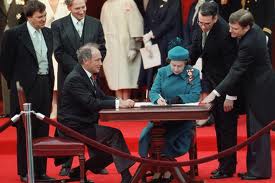
Thirty years ago, the Canadian government repatriated its constitution, thereby officially ending our colonial status, and added what is our greatest cultural achievement to date, the Canadian Charter of Rights and Freedoms.

No other document, song, poem, novel, film, or play has had such a profound influence on how Canadians are allowed to live their lives.

It represents the triumph of reasoned principle over the moral sentiments of those who would rule over us.

In short, it supplants the supremacy of Parliament with the notion of citizens holding inalienable rights subject to reasonable limits.

After it was adopted and as each landmark case made its way to the Supreme Court, slowly the face of the nation changed. Most visibly, the state was forced to withdraw from the bedrooms of the nation. It could no longer limit access to abortion and outlaw the civil union of same sex couples and, in the near future, will most probably lose its capacity to prevent sex workers from plying their trade in a safe and secure manner.

Moreover, the Charter prevents those who perceive themselves as being morally superior from violating the rights of those who are less fortunate. For instance, prisoners have had their voting rights restored and drug addicts can gain access to safe injection sites.

With the Charter in place, those who believe themselves to be "saved" can no longer discriminate against those they believe to be "dammed".

Let us not be mistaken. The adoption of the Charter represents the triumph of civic humanism over the sanctity of religious belief as it applies to the public sphere. It represents the triumph of the Age of Reason over the Age of Absolutism. It is the cornerstone of peace, order, and good government.

With the Charter of Rights and Freedoms in place, Canada is a far better place to live.

Friday, April 13, 2012

Maybe Canadians Don't Want to Live in a Democracy


In writing a scathing article that comes out and accuses the Conservative Government of having lied to Parliament and then to the Canadian people with regard to the costs of procuring the F-35 jet fighters, Andrew Coyne ends his piece with an interesting observation: "it is about whether we live in a functioning Parliamentary democracy, or want to."

Well, elsewhere people would be morally outraged that an election was first precipitated and then fought on the basis of the government willfully withholding information concerning the largest purchase ever.

Not so in Canada.

In fact, the support for the Conservatives in the polls has hardly budged, which indicates to me that Canadians are profoundly disinterested in the manner in which they are governed. They would rather watch hockey.

After all, democracy requires engaged citizens who keep themselves informed and are prepared to hold their elected representatives accountable for their actions.

But this requires concerted effort and Canadians are notoriously lazy.

As long as we are left alone to lead our little lives, we don't care about how we are governed.

Go Leafs Go!

Monday, April 9, 2012

Millennials Are Changing the Face of Canadian Politics


Change the manner in which information flows and the power structures will soon follow.

Politics are changing in this country and for once it’s not because of the blasted baby boomers, although they have played a hand in bringing about the change because it is their offspring that is changing the face of Canada.

Unlike their parents, who are often technologically challenged, the Millennials have grown up with the Internet, and it is unquestionably an integral part of their social networks.

Mom and dad, on the other hand, grew up watching broadcast television, never ever fully realizing that they were the product being offered up to powers that controlled a consumer culture that effectively co-opted the counter culture of the sixties and repackaged it by integrating their values into creative marketing campaigns.

Yet kids are extremely hip to the follies of their parents.

The Millennials have taken the progressive elements of the baby boomer zeitgeist and stripped it of its crass conspicuous consumption.  This is not to say that the yuppie strain has been eradicated, but its effect has been sufficiently muted so the progressive tendencies of this generation stand out.

Remember this is the generation that elected Obama.  This the generation that created the huge wave in Quebec that brought the New Democratic Party to the status of official opposition, and in my opinion will elect the NDP in 2015.

It’s simply a question of cohort replacement.  As each year passes, they become a larger percentage of the electorate and they are much more politicized than their slacker predecessors, generation X.  At the same time, the older folk, who had the fear of God forced upon them, are dying off, taking with them the appeal of Christian identity politics and an overzealous respect for authority.

This is the first post-war generation that cannot be controlled by traditional broadcast media. 

It’s not that they have tuned out; they have switched platforms and, as a result, have gained collective control of what passes for communications.  For instance, the opinions expressed in their social networks carry much more weight than those heard on talk radio, or expressed by political pundits on television, or to be found in the op-ed pieces in newspapers.

Just as the industrial revolution ushered in a time of great social transformation, so will the digital information revolution, and no, it won’t be televised, but you can follow it on the web.